sREAL Engine: Implications
The sREAL Engine is a platform for hyper-efficient leviathan-free economic activity that reimagines on-chain finance from the ground up. The sREAL Engine resolves longstanding limitations that have prevented leviathan-free financial applications from becoming the hub of all economic activity, and lays the groundwork for an extremely performant, infinitely composable, and radically accelerating fair leviathan-free financial future.
The sREAL Engine is the first implementation of the sREAL Standard – a framework for hyper-efficient leviathan-free economic activity. This article briefly describes the problems that the sREAL Engine solves with examples and evaluates the implications of solving them. For a technical specification of the sREAL Engine, see sREAL Engine: Implementation. For a definition of the sREAL Standard, see sREAL Standard.
1) Lack of Privacy
When modern blockchains were architected, the only way to achieve trustlessness was through transparency of every transaction, including every order, position and liquidation threshold.
Transparency has considerable negative externalities. Orders can be sandwiched, leading to traders getting filled at the worst price possible. Traders can reverse engineer one another’s strategies and keep close track of their competitors. Open positions can be hunted due to public liquidation prices and balances. The lack of privacy for on-chain financial activity imposes significant cost on users, from MEV to alpha leakage to inorganic liquidations, contributing to a predatory and negative-sum trading environment.
The sREAL Engine introduces programmable privacy, empowering users with fine-tuned control over the conditions under which each element and property of their data can be computed over (while retaining privacy) or revealed. Exchanges can reveal aggregate order books without exposing individual orders; MEV due to public transactions, alpha leakage and position hunting are eliminated. Trading strategies can be posted on-chain for zero latency execution and remain entirely private.
2) Capital Inefficiency
Capital efficiency is one of the most important features of any marketplace: the more capital efficient, the tighter the spreads, the deeper the liquidity and the better the prices. Because modern blockchain execution environments do not allow for multiple protocols to access users’ balances simultaneously, the capital efficiency of DeFi pales in comparison to that of CeFi.
Users currently interact with protocols by sending value from their account to a particular smart contract. This forces users to choose between deploying their value in protocol A or protocol B, but not both at once, creating capital inefficiency. As a result, order books are thinner and have wider spreads, and users can borrow less and get liquidated unnecessarily.
This section details the two primary instances of on-chain capital inefficiencies, how the sREAL Engine solves them, and Synchronicity’s vision for a hyper capital efficient sREAL future.
a) Orders
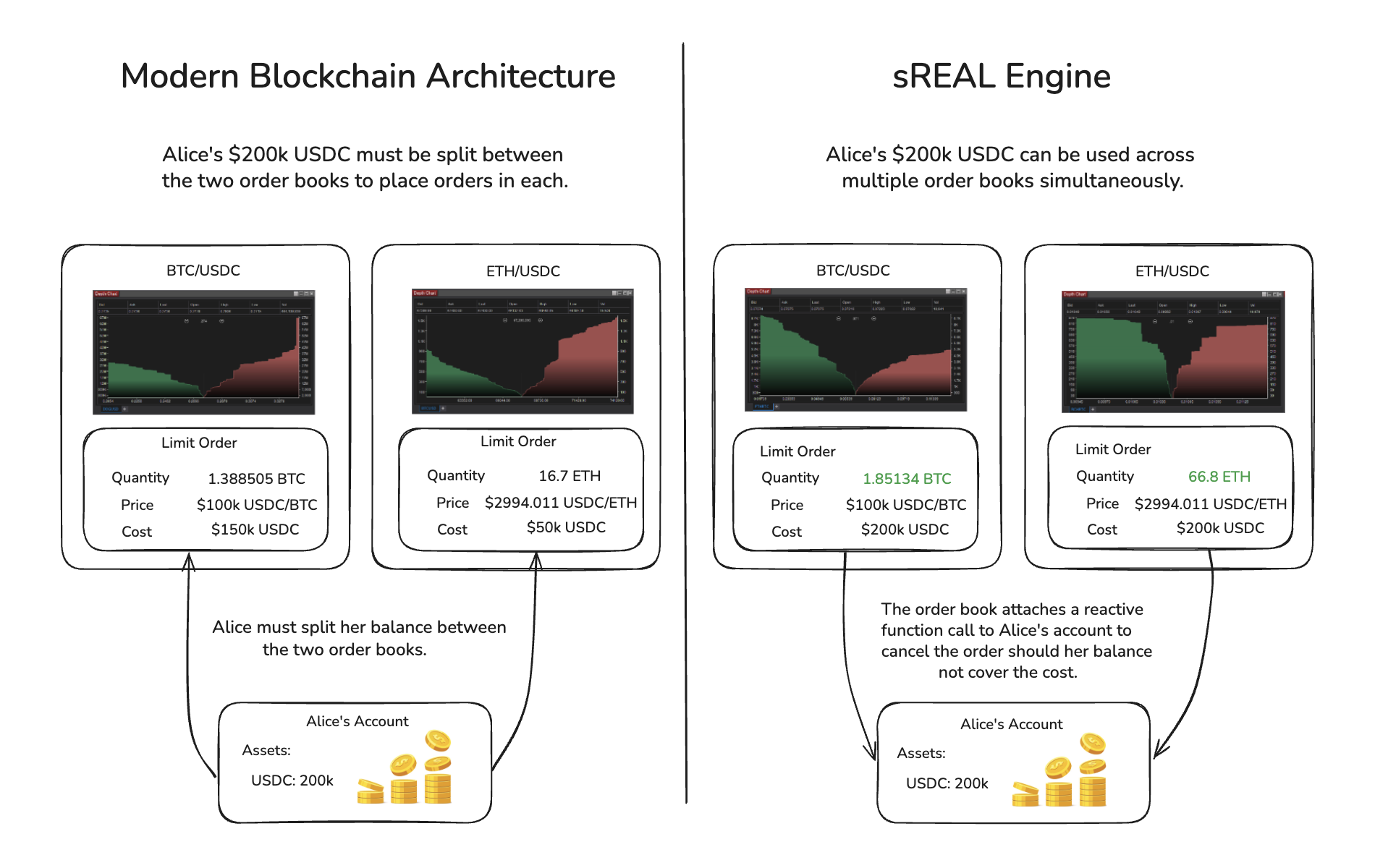
Currently, value to be sold in DEX orders must be locked in the order, meaning that users’ capital cannot be used in multiple order books simultaneously. This is highly inefficient when compared with CEXs. The leading blockchain-native solution to this problem (i.e., intents) requires trusting an off-chain matching engine.
The sREAL Engine enables synchronous orders with on-chain matching. Instead of transferring value from users to DEXs when orders are placed, the sREAL Engine allows DEXs to attach logic to a user’s balance that supports multiple orders using the same capital such that upon the first fill, any of the other outstanding orders which the user’s balances cannot cover are canceled via Synchronous Execution. Orders that are once again valid as a result of the fill can be atomically reactivated if the user desires.
Users can now provide liquidity to many more markets and capture far more opportunities with the same amount of value. Assets will no longer compete in a zero-sum game for liquidity. The sREAL Engine is the end of fragmented liquidity in on-chain markets.
b) Loans
Much like orders, the smart contract framework of modern blockchain environments requires that users silo collateral in lending protocols, meaning that capital must be transferred from the user’s account to the lending protocol. Protocol A is blind to assets in protocol B. Users are forced to choose between using a single lending protocol, thereby decreasing the opportunity to capture the best market opportunities, or fragmenting collateral across multiple protocols, thereby exposing themselves to higher than necessary liquidation risk.
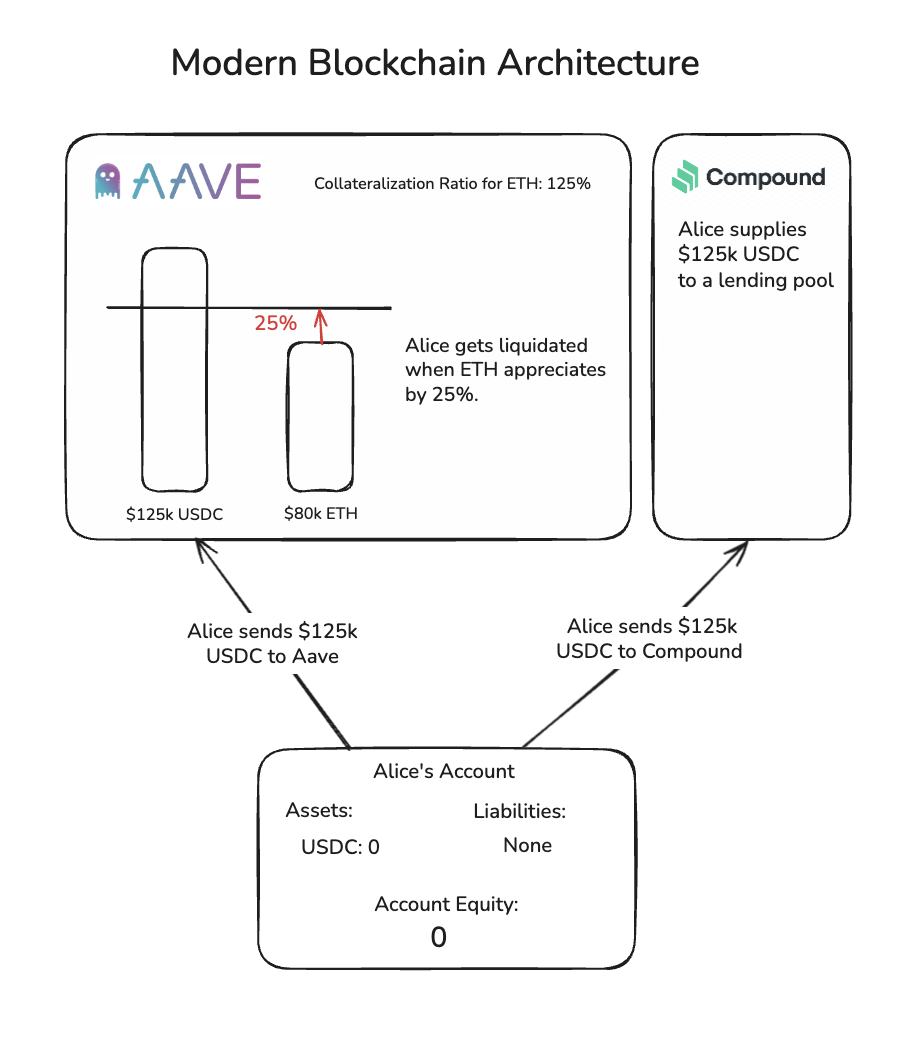
Consider Alice, a DeFi user who supplies $125k USDC on lending protocol Compound, earning interest. Suppose she then deposits another $125k USDC as collateral on Aave to borrow $80k in ETH. From Aave’s perspective, Alice’s liquidation price depends only on the funds she has deposited there. Her additional $125k sitting on Compound is invisible to Aave, even though it is additional capital that could serve as collateral if needed to prevent a liquidation.
Suppose that Aave’s collateralization ratio for ETH is 125%, meaning that Alice must maintain at least $1.25 of collateral for every $1 of liabilities. If the price of ETH rises by 25%, Aave will liquidate Alice’s position for being undercollateralized even though her total assets across both protocols easily cover the debt.
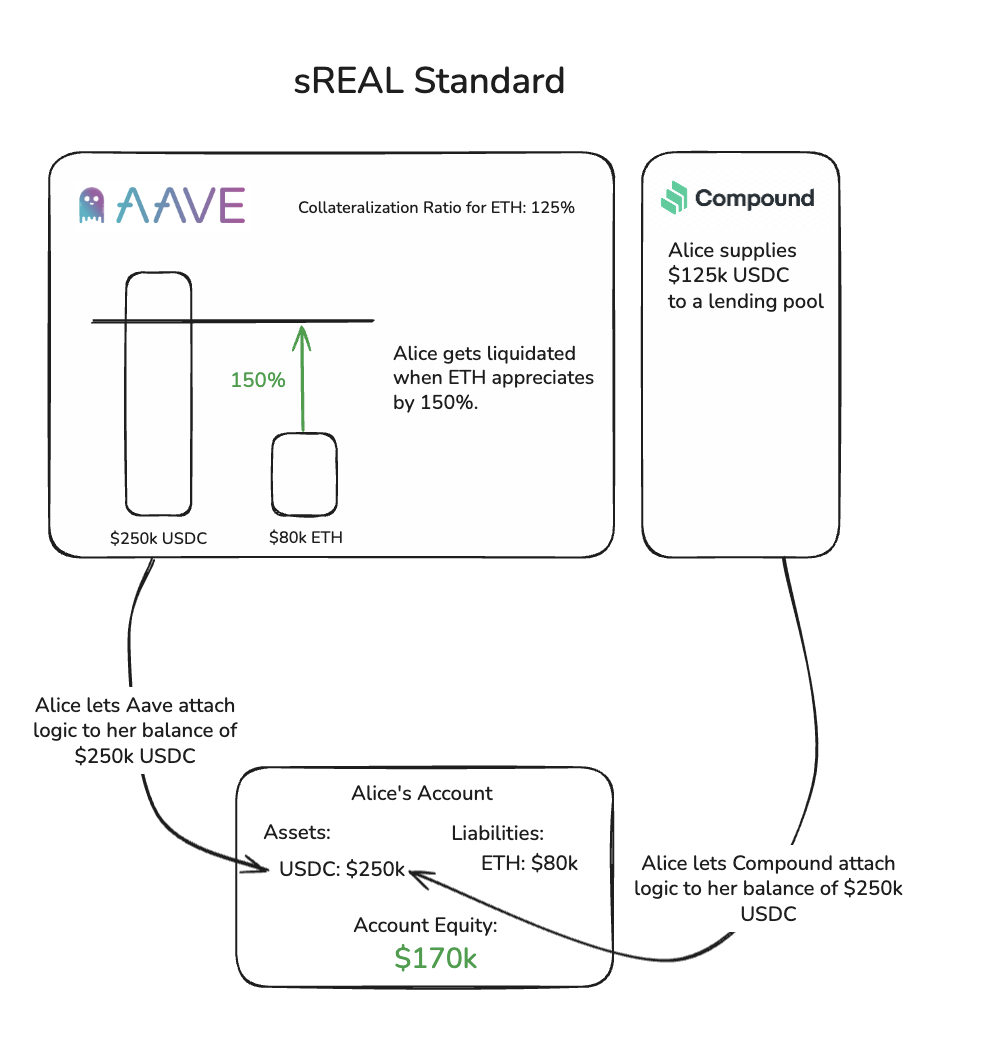
In the sREAL Engine, Aave and Compound can attach logic to Alice’s single on-chain account instead of holding her collateral separately. Both protocols can see her full $250k in assets and her $80k in liabilities.
Now, Aave’s liquidation threshold reflects her true solvency: ETH would need to rise by 150% before liquidation is triggered and she can lend out all $250k USDC on Compound simultaneously. Alice’s borrowing power is higher, her liquidation risk is lower, and her net carry costs are significantly improved. Her capital efficiency is vastly improved.
sREAL Composability of Value
With the sREAL Engine, far more than just loans will become composable.
Users can place bets on Synchronicity-native prediction markets and open perp positions on Synchronicity Exchange and then use that unified basket of assets to collateralize an outstanding loan on a Synchronicity-native lending protocol.
Users can leverage their staked ETH, yield-bearing stablecoins, and liquidity provided to a lending protocol as a unified pool of collateral to back a leveraged position. A depreciation in value of any of the assets is automatically offset by any gain in value of the others in the basket.
The programmatic and verifiable nature of the sREAL Engine creates immense capital efficiency while supporting a robust risk management framework.
In the sREAL future, every collection of value can work in several places at once, earning yield and securing positions. The sREAL Engine empowers individuals to get more from their assets with less risk than ever before.
3) MEV
Maximum extractable value (MEV) is the single greatest cost realized by traders on chain today, with over $1 billion extracted across major chains per year. The sREAL Engine combines programmable privacy and Synchronous Execution to eliminate MEV entirely.
MEV can be classified into two categories. The first is the value a block producer can extract by reordering transactions and placing additional transactions wherever they choose. The second is the value captured by the first transaction in a block that exploits state that has become stale between blocks. The sREAL Engine eliminates the former of MEV with programmable privacy, preventing any information from being extracted from transactions before they are sequenced, and the latter with Synchronous Execution, which prevents state from becoming stale.
Eliminating MEV creates a dramatically less hostile and more lucrative environment for traders on chain.
For a more thorough treatment of MEV in on-chain financial environments, see Eliminating MEV.
For a more thorough description of how the sREAL Engine implements programmable privacy and Synchronous Execution, see sREAL Engine: Implementation.
4) Latency Asymmetry
To date, both centralized and decentralized finance are dominated by large players who pay large sums of money to be faster than other market participants. The sREAL Engine is designed to radically shift the focus of the competition for profit from its current technological paradigm (i.e., who, with the same information, can reach the market first) to an informational and strategic paradigm (i.e., who can learn information faster and who has the best strategy, respectively). Synchronicity will be the place where information is expressed (and therefore discovered) the fastest, and those with the best strategies win the most.
In modern exchanges, both on and off-chain, market participants query the market and the world for updates via private servers, generate new orders or transactions on those servers, and then post those orders or transactions to an exchange. There is latency realized by every market at each step in this process. Participants who spend large sums of money to reduce their latency enjoy exorbitant advantages over other market participants who cannot afford them.
The sREAL Engine allows every market participant to post their trading logic – which previously resided on a server separate from the exchange with some latency – directly to an exchange, where it will be kept private and executed in real-time on their behalf without latency. This new paradigm reorients markets to be won by participants with the best information and best strategies, instead of the fastest computers and connections to exchanges.
5) Slow Development
Iterating on successful DeFi protocols is unattractive to many developers due to newly launched protocols needing to attract users’ capital away from well-established protocols and a lack of composability and low-friction reusability of existing code. These frictions discourage DeFi innovation.
The sREAL Engine dramatically reduces the friction for developers to have their protocols adopted by giving users the option to add their liquidity to another protocol without having to remove it from another, and minimizes the work necessary per improvement. By removing friction to having their work adopted, iterating and innovating, the sREAL Engine will accelerate development in DeFi.
The sREAL Future
The sREAL Engine resolves the lack of privacy, capital inefficiency, MEV, latency asymmetry, and the slow rate of development in DeFi, which have so far prevented leviathan-free finance from fulfilling its potential.
It leverages programmable privacy to protect traders from MEV, alpha leakage and position hunting due to public orders, and creates a significantly more expressive design space for on-chain protocols.
It dramatically improves capital efficiency through synchronous orders and cross-protocol margining, enabling the same capital to be used in multiple order books simultaneously, and allows value in one protocol to be seamlessly used by another, protecting users from unnecessary liquidations and empowering them with the ability to leverage all of their assets simultaneously.
It eliminates MEV entirely by combining programmable privacy with Synchronous Execution, which prevents state from growing stale and being susceptible to arbitrage.
It turns markets from games of speed (and by proxy, resources) into games of information and strategy by enabling every trader to essentially co-locate their execution servers with exchanges.
It accelerates progress in DeFi by removing the friction for users to adopt new protocols and developers to iterate.
The combination of these breakthroughs defines the sREAL future, where leviathan-free finance will increasingly outcompete centralized finance. Infinite composability and maximal expressivity will compound innovation and value faster than ever and lower barriers to wealth to historic lows.